Paleotemperature signals and “bioarchitecture” in ammonite mandibles

More

About the project


As the climate of the Mesozoic is equivalent to the extreme end of present-day global warming, its research can help refine climate models by providing accurate paleotemperature data. Oxygen isotope thermometry of calcitic fossils is one of the most important tools for determining paleotemperatures, which requires the detection of primary structures and late-stage alterations.

The major aims of the present proposal are:

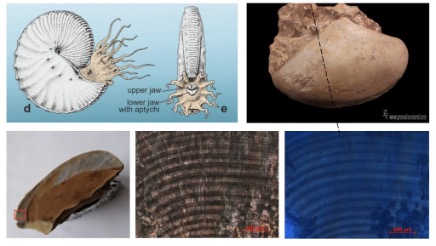
  1. Investigation the microfabric and structural characteristics and their mathematical modeling on samples from different locations and ages to determine the origin, function, and evolution of the laminated structure.
  2. Determination the calcite-water oxygen isotope fractionation relationship relevant to aptychi and rhyncholites. A combination of oxygen and clumped isotope analyses will be applied to provide precise paleotemperature calculations.
  3. Determination of accurate and reliable paleotemperature data by analyzing aptychus, rhyncholite, belemnites and brachiopod fossils with the aim of clarifying Mesozoic climate conditions and the paleolatitudinal distribution of global temperature over the Jurassic and Cretaceous.

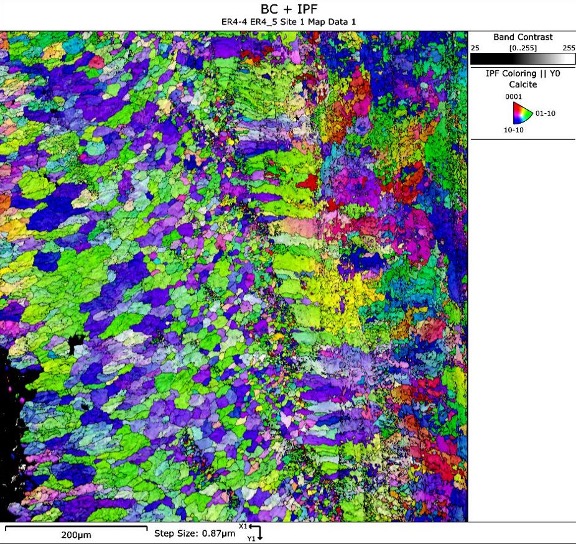
This project will be the first to study the calcite structures of aptychi and rhyncholites using mathematical modeling, the combination of various microscopic techniques and EBSD, as well as traditional, clumped isotope and SIMS techniques. The modeling of calcite structures may have material science implications in bioarchitecture-inspired material developments. This project will attract students in addition to the currently participating MSc students. The results will be presented at international conferences and project-related workshops, and will be published in leading journals, but public outreach will also be a major goal.

News


Publication Image

Coming soon...

March 2026

Tovább

Publications


Preliminary publications underpinning the project

Calcitic coverings of the lower jaw of Jurassic ammonites exhibit Bouligand-like structures

Attila Demény, László Bujtor, Gábor Domokos, András A Sipos, Csaba Farkas, Eszter Ferencz, Boglárka Topa, Máté Leskó, Norbert Zajzon (2025). Communications Earth & Environment 6 (1), 927

Tovább a cikkre

Laevaptychi as reliable paleotemperature archives: high-resolution stable isotope compositions of Kimmeridgian (Jurassic) lamellar structured aspidoceratid lower mandibles from Zengővárkony (Mecsek Mountains, Hungary)

Bujtor, L., Demény, A., Németh, P., Bajnóczi, B. (2024). International Journal of Earth Sciences 113, 353 – 367

Tovább a cikkre

Ismeretterjesztés


National Geographic

Publication Image

Magyar kutatók jöttek rá az ősi állatok titkára

December 2025

Tovább

HUN-REN News

Publication Image

Ásványtani és geometriai modellezéssel tárták fel a HUN-REN kutatói, hogyan működött a százmillió éves lábasfejűek rágószerve

December 2025

Tovább

BME News

Publication Image

Magyar kutatók fejtették meg a jura kori ammoniteszek rendkívüli rágószervének titkát

November 2025

Tovább

Project participants


Szlovénia

Ivan Rakovec Institute of Palaeontology ZRC SAZU (IRIP), Ljubljana

Tim Cifer

PhD

Personal website

Špela Goričan

PhD, member of the Slovenian Academy of Sciences and Arts

Personal website

Aleksander Horvat

PhD

Personal website

Anja Kocjančič

Research assistant

Personal website

Hungary

HUN-REN Research Centre for Astronomy and Earth Sciences, Institute for Gological and Geochemical Research

Attila Demény

DSc, full member of the Hungarian Academy of Sciences, PI

Personal website

Péter Németh

PhD

Personal website

Bernadett Bajnóczi

PhD

Personal website

Csaba Farkas

young researcher


Eszterházy Károly Catholic University

László Bujtor

PhD


Eötvös Loránd University

József Pálfy

DSc, full member of the Hungarian Academy of Sciences


HUN-REN ATOMKI

László Rinyu

PhD


University of Miskolc

Norbert Zajzon

PhD

Boglárka Topa

MSc


HUN-REN-BME Morphodynamics Research Group

Gábor Domokos

DSC, full member of the Hungarian Academy of Sciences

András Sipos

PhD

Eszter Ferencz

MSc


HUN-REN EK Institute of Technical Physics and Materials Science

Levente Illés

MSc